Tree removal in Franklin, from the first walk-through to the last load hauled.
A mature hardwood comes down in a fixed order: assess, rig, lower, clear. We keep to that order on every Franklin removal, whatever the size of the tree or what stands beneath it.
The trees Franklin asks us to remove
Most of our removal calls concern the county’s big, aging hardwoods. Ash trees lost to the emerald ash borer, standing dead and getting brittle. Hackberries that have shed one limb too many onto the same patch of roof. Silver maples that grew fast, split at the union, and now lean over the kitchen. And every so often a genuinely grand white oak or sugar maple at the end of its run — a removal nobody is happy about, done respectfully.
Plenty of trees that scare their owners are pruning jobs, not removals. Where pruning and trimming will keep a healthy tree standing safely, the estimate says exactly that and prices the pruning instead. Removal is for the trees that are dead, structurally failing, or positioned where no amount of trimming makes them safe.
What will a Franklin removal cost you?
The market’s center of gravity is about $850. The mature oaks and maples this county is full of run $850 to $2,000, and anything over eighty feet runs $1,200 to $2,500 and up once serious rigging or crane time joins the job. Emergency work after a storm bills at two to three times the standard rate.
Height, what the tree overhangs, and how the crew can reach it decide where your tree lands in those ranges. The Franklin pricing guide takes those factors one at a time, with this year’s figures.
How the work proceeds
It begins with a visit. We look at the tree, the ground under it, the route out of the yard, and anything the tree could touch on the way down. You receive a free itemized estimate: one line for the removal, one for stump work if you want it, one for hauling. Nothing is bundled where you can’t see it.
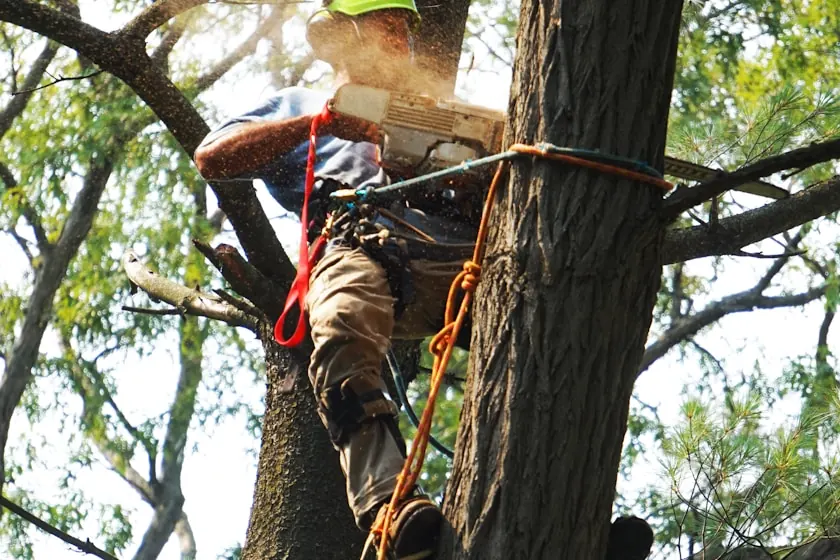
On the day, the tree comes down from the top, in sections. Limbs over the house, the fence, or the garden are roped and lowered under control rather than dropped. The trunk follows in measured lengths. Then the yard is cleared, the surfaces are swept, and you walk the property with us before the trucks leave.
The estimate you approve is the estimate you are billed against. If the tree turns out to hold a surprise once we are up in it, we come down and talk it through with you before anything changes.
Removing trees over eighty feet
Franklin’s older lots carry hardwoods that have had generations to get tall, and the tallest of them are their own category of work. Above roughly eighty feet, rigging points multiply, sections get heavier, and some trees can only come down with a crane on the street. That is why the top of the local price band reaches $2,500 and beyond — the mature-hardwood lots this county is known for hold exactly the trees that reach it. It is careful, unhurried work, and it is the part of the trade we take the most pride in.
Where the wood goes, and what becomes of the stump
Your call, and your estimate reflects it. Unless you tell us otherwise, everything leaves with us — limbs, brush, and trunk. If you heat with wood, we can buck the trunk into rounds and leave them stacked, which lowers the price. We quote the stump separately: grind it out the same day, or leave it for another season. The stump removal page explains the grinding process and what it leaves behind.
Common questions about removal
- What do Franklin’s big oaks and maples cost to remove?
- Large removals in Franklin generally run $850 to $2,000, and a tree over eighty feet runs $1,200 to $2,500 or more once serious rigging or a crane joins the job. The estimate is free, itemized, and specific to your tree.
- What happens on the day of the removal?
- The crew arrives in the window we set, protects the lawn and beds under the tree, brings the tree down in sections from the top, and clears as it goes. Before we leave, you and the crew check the yard together and confirm the work matches the estimate you approved.
- Is stump grinding a separate charge?
- Yes — it appears on the estimate as its own item, priced before you decide. Most people approve it on the spot, because bringing equipment back another day costs more than grinding while everything is staged.
- Do you take storm-damaged trees ahead of scheduled work?
- Yes. A tree on a roof or across a driveway moves to the front of the schedule. Count on emergency rates of two to three times standard — the crew works at the pace safety sets, on wood that is loaded and unpredictable, in a week full of storm calls. When a day’s wait is safe and cheaper, we say so before booking anything.
Have us look at the tree.
Call and describe it, or send the estimate request and we will come see it in person. Phone or form, the look costs you nothing.